| |
|
|
|
| |
 |
|
Summary
Mary proclaimed herself "the Mother of the true God who gives
life" and left her image permanently upon the tilma of St.
Juan Diego, a man newly converted to Christianity. Her likeness
was given as a sign to Bishop Zumarraga, who abided by her wishes
and constructed a church on Mt. Tepeyacac, the site of the apparitions.
Millions of natives were converted to Christianity during the period
following her visit. Our Lady of Guadalupe has been designated as
the Patron Saint of the Americas. |
|
| |
|
|
|
|
Timeline
| 1474 |
Quauhtlatoatzin (Juan Diego) is born in Cuautitlan. |
| 1476 |
Juan de Zumarraga was born in Spain. |
| 1492 |
Christopher Columbus lands on an island in the Americas and
named it San Salvador. |
| 1514 |
The first Marian Shrine in the New World is established in the
city of Higuey.
|
| 1519 |
Hernan Cortez lands in Mexico. |
| 1521 |
The capital city of the Aztecs falls under Cortez. |
| 1524 |
The first 12 Franciscans arrive in Mexico City. |
| 1525 |
Quauhtlatoatzin is baptized by a Franciscan priest and receives
the Christian name of Juan Diego. |
| 1528 |
Friar Juan de Zumarraga arrives in the New World. |
| 1529 |
Juan Diego’s wife, Maria, dies. |
| Dec 9, 1531 |
The Virgin appears to Juan Diego on top of mount Tepeyacac speaking to him in Nahuatl, his native tongue. She called him “Xocoyte,” her little son. She
requests that he petition the bishop of Mexico that a “teocalli,” a sacred little house, be
built on the spot. Juan Diego, calling her her “Xocoyata,” his littlest daughter, agrees to comply with her mandate
and meets with the Bishop who listens to the message but does not
believe his words. On his return he encounters the Virgin again
who insists that he return to the Bishop with the same message the
next day. |
| Dec 10, 1531 |
Juan does not return to the bishop the next day because his
uncle Juan Bernardino takes ill and requests Juan Diego to find
a priest for his final confession. |
| Dec 11, 1531 |
Juan goes from his home to Tlatilolco to summon a priest and
despite trying to avoid her, encounters along the way the Virgin
who promises that his uncle will be cured. She urges him to climb
to the top of the hilltop and gather the roses growing there in
December as the sign for the Bishop to believe. When the Bishop
finally received him, Juan unfurled his tilma and revealed the image
of the Virgin miraculously painted there. |
| Dec 12, 1531 |
Juan Diego shows the Bishop the location of the apparition on
which the church was to be built. He then returned to his uncle
who was cured of his illness and had an experienced a visitation
from the Virgin himself. |
Dec 24, 1531 |
Bishop Zumarraga writes a letter to Cortez
stating: "I want to dedicate my cathedral to the Immaculate
Conception because it was during that feast that God and his Blessed
Mother deigned to shower the land you won with great favor." |
| 1533 |
The first sanctuary is erected at the request of the Virgin. With the Bishop's permission, Juan Diego lived the rest of his life as a hermit in a small hut near the chapel where the miraculous image was placed for veneration. Here he cared for the church and the first pilgrims who came to pray to the Virgin. |
| 1541 |
Franciscan priest and early historian of New Spain “Motolinia”
writes that some nine million Aztecs had become Christians |
1548 |
Bishop Juan de Zumarraga dies. |
| May 30, 1548 |
Juan Diego dies and is buried in the first chapel dedicated to the Virgin of Guadalupe.
(The Codex 1548 is discovered in 1995 in a private collection. it commemorates the death of Juan Diego in 1548 and provides the earliest illustration of him and the earliest reference to his birth name, Cuauhtlatoatzin. It is signed by Antonio Valeriano and Bernardindo de Sahagun.) |
June 1554 |
Alonso de Montúfar was consecrated in 1553 and finally reached his see in Mexico City as the second archbishop of Mexico. |
| 1555 |
In the Provincial Counsel, the second archbishop of Mexico,
Alonso
de Montúfar (1551-1572), formulates canons that indirectly approved
the apparitions. |
| 1556 |
Archbishop Montúfar begins the erection of the second
church. |
| 1561 |
The Valeriano Relation
(the Nican Mopohua) is written by an Indian named Antonio Valeriano
between 1551 and 1561. |
| 1564 |
An image is carried on the first formal expedition to the Philippine
Islands. |
| 1567 |
The new church ordered by Archbishop Montufar is completed. |
1570 |
Archbishop Montufar sends an oil painted copy of the image of
Guadalupe to King Philip II of Spain. |
| 1571 |
Admiral Doria carries a copy of the image aboard ship during
the battle of Lepanto and attributes the victory over the Ottoman
Empire to the Virgin of Guadalupe |
1573 |
The “Primitive Relation” is written by the historian
Juan de Tovar, who transcribed the story from a still earlier source,
probably Juan Gonzalez, Bishop’s Zumarraga’s translator.
|
| 1647 |
The image is covered with glass for the first time. |
1648 |
The priest Miguel Sanchez publishes “Image of the Virgin
Mary, Guadalupan Mother of God” in Mexico City. |
| 1649 |
Luis Lasso de la Vega publishes the “Huey Tlanahuicoltica”,
telling the story in Nahuatl. It refers to earlier Nahuatl sources. |
1666 |
A formal inquiry and investigation, named Informaciones Guadalupana, is conducted by the Church
from February 18 to March 22. Juan Diego was called a "holy man". |
| 1695 |
The first stone of the new sanctuary is laid.. |
1709 |
The new sanctuary is solemnly dedicated. |
| 1723 |
Another formal investigation is ordered by Archbishop Lanziego
y Eguilaz. |
1737 |
The Most Holy Mary of Guadalupe is chosen as the patroness of
the city of Mexico. |
| 1746 |
The patronage of Our Lady of Guadalupe is accepted for all of
New Spain (California to El Salvador). |
1746 |
The knight Boturini Benaducci promotes the solemn and official
coronation of the image. |
| May 25, 1754 |
Benedict XIV approves the patronage of New Spain and granted
a Mass and Office proper to the celebration of the feast on December
12. |
1756 |
Painter Miguel Cabrera publishes his extensive study of the Image
in the book “American Marvel”. |
| 1757 |
The Virgin of Guadalupe is declared patroness of the citizens
of Ciudad Ponce in Puerto Rico. |
1767 |
The religious of the Society of Jesus are expelled from the Spanish
dominions, and the image is carried to various parts of the world. |
| 1895 |
The coronation of the image is performed, with pontifical authority
and the a great part of the episcopate of the Americas in attendance. |
1910 |
Pius X declares the Virgin of Guadalupe Patroness of Latin America. |
| 1911 |
A church is built on the site of Juan Bernardino’s home. |
1921 |
A bomb placed beneath the image explodes but the tilma survives. |
| 1924 |
A very important 16th century source documenting the miracle
is found in Tetlapalco, Peru in 1924 by anthropologist M.H. Saville. It is a pictorial
calendar known as the Codex Saville-Tetlapalco and shows the image
of our Lady located in the position representing the year 1531. |
1928 |
A coronation of the image was made in Santa Fe, Argentina. |
| 1929 |
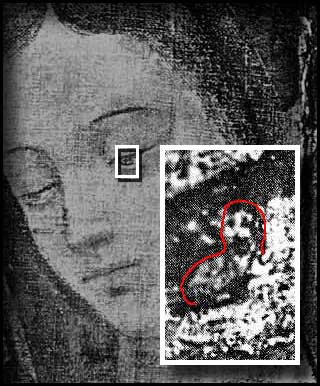
First documented note of an apparent reflected image of a man’s
head in the right eye of the Virgin, by photographer Alfonso Marcue. Alfonso Gonzales, a photographer of the Basilica of Guadalupe, after studying the negative of the image, found what seemed to be a clear image of a bearded man reflected in the right eye. |
1935 |
Pius XI extended the patronage of the Virgin of Guadalupe to
the Philippines. |
| 1945 |
Pius XII states that the Virgin of Guadalupe was the “Queen
of Mexico and Empress of the Americas” and that she had been
painted “by brushes that were not of this world”. |
1946 |
Pope Pius XII declares her to be the Patroness of the Americas. |
| 1951 |
Carlos Salinas examines the tilma and observes the apparent
reflection of a man’s
head in the right eye of the Virgin |
1956 |
Dr. Torroela-Bueno, an ophthalmologist, examines the eyes of
the Virgin on the tilma. |
| 1958 |
Dr. Rafael Torija-Lavoignet publishes his study of the Purkinje-Sanson
effect as exhibited in the Guadalupan image. |
1961 |
Pope John XXIII prays to her as Mother of the Americas. He addresses
her as Mother and Teacher of the Faith to the peoples of the Americas |
| 1962 |
Dr. Charles Wahlig, O.D. announces the discovery of two images
apparently reflected in the eyes of the Virgin when studying a photograph
enlarged twenty five times. |
1966 |
Pope Paul VI sends a Golden Rose to the Basilica. |
| 1975 |
Glass is removed so the image could be examined by another ophthalmologist,
Dr. Enrique Grave. |
1976 |
The New Basilica of
Our Lady of Guadalupe, located four miles from central Mexico
City, is dedicated. |
| 1979 |
Dr. Philip Callahan takes 40 frames of infra-red photographs
of the image. Later concluded that the original image is unexplainable
as a human work. |
1979 |
Pope John Paul II called her the “Star of Evangelization”,
knelt before her image, invoked her motherly assistance and called
upon her as Mother
of the Americas. |
| 1979 |
Dr. Jose Aste-Tonsmann announces
the finding of at least four
human figures apparently reflected in both eyes of the Virgin.
Dr. Tosmann used sophisticated image processing techniques with
digitized photographs of both eyes. |
December 22, 1981 |
At the Observatory Laplace Mexico City, Father Mario Rojas and Dr. Juan Hernández Illescas, a medical doctor and amateur astronomer, performed an astronomical study of the Image and analyzed the stellar arrangement that appear in the Mantle of Our Lady. They surprisingly discovered that the stars stunningly and accurately map out the various constellations of the Mexican sky. Even more remarkable is the "star map" on the mantle is in the reverse (the cardinal axis rotated 90 degrees counterclockwise): providing a view of the constellations from beyond them, as would be seen looking through them towards the earth. The constellations are consistent with what astronomers believe was in the sky above Mexico City on the day the apparition occurred - in the winter-morning solstice of December 12, 1531, Saturday, at 10:26AM. |
1987 |
The Congregation for the Causes of Saints declares Juan Diego venerable. |
1988 |
The liturgical celebration of Our Lady of Guadalupe on December
12 is raised to the status of a feast in all dioceses in the United
States. |
| May 6, 1990 |
Juan Diego is beatified by Pope John Paul II in the Basilica of Santa Maria de Guadalupe, Mexico City. The Pope declares Dec. 9 the feast of Juan Diego and invokes him as “protector and advocate of the indigenous peoples.” |
| 1992 |
Pope John Paul II dedicates a chapel in honor of Our Lady of
Guadalupe in St. Peter’s Basilica. |
1995 |
The Codex 1548 (also known as Codex Escalada) is discovered in a private collection. it commemorates the death of Juan Diego in 1548 and provides the earliest illustration of him and the earliest reference to his birth name, Cuauhtlatoatzin. It features a pictogram of Antonio Valeriano and a signature of Bernardino de Sahagún. |
1996 |
Controversy over the historical authenticity of Juan Diego is stirred by Father William Schulenburg, a longtime abbot of the Basilica of Our Lady of Guadalupe, who calls Juan Diego a "mythical character". |
July 31, 1997 |
Father Xavier Escalada, S. J. published an illustration of the apparition with the signature of Don Antonio Valeriano dated 1548 was recently uncovered in a private collection in 2002 was named "Codex of 1548" or "Codex Escalada". The Codex has been scientifically studied and determined to be genuine, and substantiates the historical basis of the apparition of Guadalupe.
The English literal translation is as follows:
"Ten years after the seizure of the city of Mexico, war came to an end and there was peace amongst the people; in this manner faith started to bud, the understanding of the true God, for whom we live. At that time, in the year fifteen hundred and thirty one, in the early days of the month of December, it happened that there lived a poor Indian, named Juan Diego, said being a native of Cuautitlan. Of all things spiritually he belonged to Tlatilolco." |
Oct. 28, 1998 |
The Vatican subsequently established a commission of 30 researchers from various countries to investigate the question of the historical authenticity of Juan Diego. The commission successfully proved that Juan Diego had indeed existed, and the results of their research were presented to the Vatican Congregation for the Causes of Saints. Among research documents submitted at that time were 27 Guadalupe Indian documents. One called the “Escalada,” co-authored by Valeriano and Franciscan Friar Bernardino de Sahagun, contained a death certificate of Juan Diego. |
March 25, 1999 |
Pope John Paul II, during his
third visit to the sanctuary, declares the date of December
the 12th as a Liturgical Holy Day for the whole continent. Read the declaration. |
| July 31, 2002 |
Juan Diego is canonized
by Pope John Paul II in Mexico City. |
Dec 12, 2011 |
Pope Benedict XVI stated:
The venerated image of the Black Madonna of Tepeyac, with her sweet and peaceful countenance, imprinted on the tilma of the indio St. Juan Diego, shows her as “the ever Virgin Mary, Mother of the True God from whom she lives” (From the Office of Readings. Nicán Mopohua, 12th ed., Mexico City, D.F., 1971, 3-19).
She reminds us of the “woman clothed with the sun, with the moon under her feet, and on her head a crown of twelve stars; she was with child” (Rev 12:1-2).
She signals the presence of the Savior to the indigenous and mestizo population.
She always leads us to her divine Son, who is revealed as the foundation of the dignity of every human being, as a love that is stronger than the powers of evil and death, and the fountain of joy, filial trust, consolation and hope.
|
Photo Gallery
Click here to view
images from Guadalupe.
Messages
The Blessed Virgin appeared four times to Juan Diego. In her messages
she asked for his obedience in petitioning Bishop Zumarragato erect a
church on the hill of Tepeyacac.
Click here to
read the messages from Guadalupe.
Miracles and Signs
| 
|
The tilma was made from cactus fibres and as such
should have turned into dust after approximately twenty years. Instead
it has survived and been on diplay to the faithful for nearly 500
years despite being exposed to the smoke of candles throughout the
centuries. Infrared spectroscopy has confirmed the integrity of
the image.
The image on the tilma is composed of pigments that have not been
identified by chemical analysis as being the product of animal,
vegetable, or mineral dye. No undersketch has been identified below
the painting. |
Symbolism
The 470-year-old image of Our Lady of Guadalupe is more than simply a picture. It contains
symbols -- in a sense, hieroglyphics, or a story in pictures -- that reveal part of the message the Blessed Mother brought through Juan Diego to the Indians of Mexico and to all the people of the Americas. But the symbols had a special meaning to the Indians, who because of their culture could decipher the code in the Image.

|
1. Eyes
The eyes of the image are looking down, a postion of humility, revealing that, as great as she is, she is not a god. Indian gods never looked down; they looked straight ahead. |

|
2. Face
The woman's face shows great compassion. The Indians felt that the face was the window of the inner person, a means by which one could read who a person was -- the way a person would act. A good woman to the Indians was one whose femininity showed in her face. The head of the woman in the image shows her with dark skin and dark hair like that of the Indians. |
|
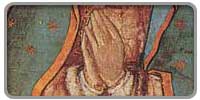
3. Hands
Her hands are not poised in the traditional Western style of prayer, but in an Indian manner of offering, indicating that something is being offered, that something is to come from her. |
|
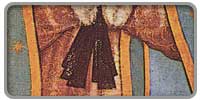
4. Maternity Band
The maternity band around the woman's waist was the sign of a pregnant woman, a mother who is about to give birth, it was a sign to the Indians that someone is yet to come. |
|
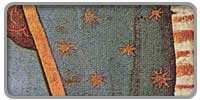
5.
Stars
The stars on the mantle are a sign that a new civilization, or era, is beginning. The Indian tradition recognized the end and the beginning of different eras throughout the ages, and the destruction of a particular civilization or era was always accompanied by a comet, or a body of stars. |

|
6. Sun Rays
The rays of sun in the image recalled for the Indians that the sun played a key role in their civilization. But the woman in the image is greater than even the sun. She hides the sun, and only the rays come forth. She hides the sun but does not extinguish it. |

|
7. Mantle
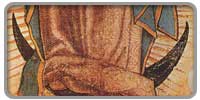
The predominant color in the image's mantle is turquoise, the blue-green color reserved for the great god Omecihuatl. Although the Indians had many "intermediary gods." Omecihuatl was considered the supreme god. It was a mother-father god who sometimes was represented as a man and sometimes as a woman. It was a source of unity for everything that exists. |
|
8. Moon
The woman is standing on the moon, indicating that she is greater than the god of night, the moon god. |

|
9. Angel
The angel at the bottom of the image was seen by the Indians as an "intermediary god" carrying in a new era, the beginning of a new civilization. One era was at an end -- had died -- and a new one was beginning, was being born. |
Star Pattern
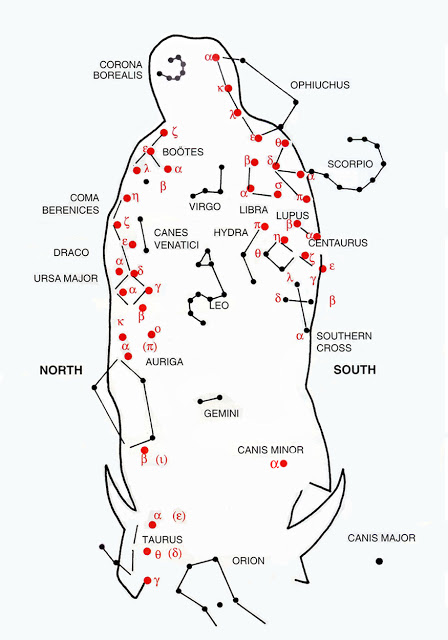 |
On December 22, 1981, at the Observatory Laplace Mexico City, Father Mario Rojas and Dr. Juan Hernández Illescas, a medical doctor and amateur astronomer, performed an astronomical study of the Image and analyzed the stellar arrangement that appear in the Mantle of Our Lady. They surprisingly discovered that the stars stunningly and accurately map out the various constellations of the Mexican sky. Even more remarkable is the "star map" on the mantle is in the reverse (the cardinal axis rotated 90 degrees counterclockwise): providing a view of the constellations from beyond them, as would be seen looking through them towards the earth. The constellations are consistent with what astronomers believe was in the sky above Mexico City on the day the apparition occurred - in the winter-morning solstice of December 12, 1531, Saturday, at 10:26AM.
Our Lady's cloak has 46 stars: 22 on her right side, and 24 on her left side. These 46 stars are the most brilliant stars that surround the horizon of the Mexican Valley which have been identified. The main constellations of the Northern sky can be seen on the right of the mantle. On the left, the Southern ones which can be seen from the Tepeyac in winter at dawn. The East is situated in the upper part and the West in the lower part. The Mantle is opened and there are other groups of stars which are not marked in the Image, but they are present in the sky. The Boreal Crown is located above the Virgin's head; Virgo is on her chest, in the region of her hands. Leo on Her womb, precisely above the sign of Nahui Ollin, with his main star Regulo, the small king. Gemini, the twins, is found in the region of the knees and Orion is located where the Angel is. |
Additions and Embellishments

Excerpted from Exploring the Miraculous (OSV):
On May 7, 1979, Philip Serna Callahan, an accomplished biologist who has written fourteen books and two hundred scientific papers, was invited by the rector of the shrine, Msgr. Enrique Salazar, to conduct infrared photographic tests on the tilma. Infrared photography allows the scientist to obtain “historical data of the historical derivation, the method of rendition and the validity of documents and paintings.” Between 9 p.m. and midnight, he took forty exposures, from a distance and close up, and concluded that the original image had been substantially embellished
over the years.The first additions were the moon and the tassel, followed by the gold and black decorations, the angel, and the fold in robe, the sunburst, and the background.The elements that were found to be original are the red robe, the blue mantle, the face, and the hands. Callahan noted:
In terms of this infrared study, there is no way to explain either the kind of color pigments, or the maintenance of color luminosity and brightness over the centuries. When consideration is given to the fact that there is no under drawing, sizing or over varnish, and the weave of the fabric itself is utilized to give the portrait depth, no explanation of the portrait is possible by infrared tech- niques. It is remarkable that after more than four centuries there is no fading or cracking of the original figure on any portion of the agave tilma, which should have deteriorated centuries ago. (Philip Serna Callahan, The Tilma under Infra-Red Radiation, CARA Studies on Popular Devotion, vol. 2, Guadalupan Studies, no. 3 (Washington, DC: Center for Applied Research in the Apostolate, 1981).
Visionary
St. Juan Diego was born in 1474 with the name "Cuauhtlatoatzin" ("the talking eagle") in Cuautlitlán, today part of Mexico City, Mexico. He was a gifted member of the Chichimeca people, one of the more culturally advanced groups living in the Anáhuac Valley.
When he was 50 years old he was baptized by a Franciscan priest, Fr Peter da Gand, one of the first Franciscan missionaries. On 9 December 1531, the Blessed Mother appeared to him on Tepeyac Hill, the outskirts of what is now Mexico City.
With the Bishop's permission, Juan Diego lived the rest of his life as a hermit in a small hut near the chapel where the miraculous image was placed for veneration. Here he cared for the church and the first pilgrims who came to pray to the Mother of Jesus.
Church Approval
In 1555 In the Provincial Counsel, the second archbishop of Mexico,
Alonso de Montúfar, formulated canons that indirectly approved
the apparitions. A formal inquiry and investigation was
conducted by the Church from February 18 to March 22, 1666 and again by
Archbishop Lanziego y Eguilaz in 1723.
Juan Diego was beatified on May 6, 1990 and canonized
by Pope John Paul II on July 31, 2002. His feast day is December 9th.
Pope John Paul II, during his
third visit to the sanctuary on March 25, 1999, declares the date of December
the 12th as a Liturgical Holy Day for the whole continent. Read the declaration.
The Feast Day of Our Lady of Guadalupe is December 12th.
Prayers
Meditation
|
Oh Lord God Who sent the Virgin of Guadalupe to us, please let her image remain a beacon to the world and especially a sign to those who would destroy the unborn. Oh Jesus: please end abortion. Please end euthanasia. Please end illicit birth control. Please end suicide. Please, oh Lord, let us all have life and life more abundantly. Let us all conform ourselves to a style of living that is in conformance with Your creation, with a style of life that is clean and simple and unselfish. Let us focus on the plight of our youngsters, the children who enter a world of such spiritual harassment. Please, oh Lord, let us live a life as humble as that of Juan Diego that like him we may be ever- conscious of death and always prepared for it. Oh Lord, always let us be prepared. Always remind us of Confession. Always remind us that humility and lowliness are grand in your sight (even if they are disdained by this blinded world). Heal any of our plagues as your original image from St. Mary Major healed plagues and as the shrine in Spain healed pilgrims and as you healed Juan's uncle of cocolistle. Heal infectious disease among us and our families. Heal such disease throughout society, good Lord, and when we are ill, please, oh Holy Spirit: please grant us the trust you requested of Juan Diego, that nothing should cause us grief or fear.
Let us pray (response: pray for us):
Oh Virgin who gives us prodigies,
Oh Virgin who teaches strength,
Oh Virgin who takes away fear,
Oh Virgin who instills trust,
Oh Virgin, who watches over our children,
PRAY FOR US
Prayer for the sick
Immaculate Mother, Blessed Virgin Mary of Guadalupe, health of the sick, your anointed heavenly hands healed Juan Bernardino and brought us the River of Light, of Life, and of Health: Into your heavenly hands I commend my faith, my hope, and all my sufferings. Please unite them to the Passion of your Son, Jesus Christ, that they may serve as instruments of my salvation and the salvation of all my brothers and sisters. From this moment on, I accept all that the Sacred Heart of your Son may wish to send me. I desire to complete in my life what is lacking to His redeeming Passion. Oh Blessed Virgin Mary of Guadalupe, I trust that you will give me the strength and all that I need to live with spiritual health and if it serves God's glory and my true well-being, you will give me my physical health also.
Ejaculation:
Oh Mary, so motherly, so kind, heal us and make us whole and let us always be under your
glorious turquoise mantle!
Prayer of John Paul II:
Virgin of Guadalupe
Mother of the Americas...
grant to our homes the grace of loving and
respecting life in its beginnings,
with the same love which you conceived in
your womb the life of the Son of God.
Blessed Virgin Mary, Mother of Fair Love,
protect our families, so that they may always be united, and bless the upbringing of
our children.
We beg you grant us a great love for all the
holy Sacraments, which are, as it were, the
signs that your Son left us on earth.
Thus, Most Holy Mother,
with the peace of God in our conscience,
with our hearts free from evil and hatred,
we will be able to bring to all true joy and
true peace, which come to us from your Son,
Our Lord Jesus Christ, Who with God the Father
and the Holy Spirit, lives and reigns forever
and ever. Amen.
Prayer of Pope Benedict XVI - May 13th 2005, Vatican Gardens
Holy Mary, who under the advocacy of Our Lady of Guadalupe, are invoked as mother of the men and women of the Mexican nation and of Latin America, encouraged by the love you inspire in us, we again place our lives in your maternal hands. You who are present in the Vatican Gardens, reign in the hearts of all mothers of the world and in our hearts. With great hope, we come to you and trust in you.
"ORACIÓN A NUESTRA SEÑORA DE GUADALUPE"
DADA A CONOCER POR LA PONTIFICIA COMISIÓN PARA AMÉRICA LATINA
Virgen María de Guadalupe,
Madre del verdadero Dios por quien se vive.
En San Juan Diego, el más pequeño de tus hijos,
Tú dices hoy a los pueblos de América Latina:
¿No estoy yo aquí que soy tu Madre?
¿No estás bajo mi sombra?
¿No estás por ventura en mi regazo?
Por eso nosotros con profundo agradecimientoreconocemos a través de los siglostodas las muestras de tu amor maternal, tu constante auxilio, compasión y defensade los moradores de nuestras tierras, de los pobres y sencillos de corazón.
Con esta certeza filial, acudimos a ti, para pedirte, que así como ayer vuelvas a darnos a tu Divino Hijo, porque sólo en el encuentro con Élse renueva la existencia personaly se abre el camino para la edificación de unasociedad justa y fraterna. A ti, ‘Misionera Celeste del Nuevo Mundo’, que eres el rostro mestizo de Américay luminosamente manifiestas su identidad, unidad y originalidad, confiamos el destino de nuestros Pueblos.
A ti, Pedagoga del Evangelio de Cristo,Estrella de la Nueva Evangelización,consagramos la labor misioneradel Pueblo de Dios peregrino en América Latina.
¡Oh Dulce Señora!,
¡Oh Madre Nuestra!,
¡Oh siempre Virgen María!
¡Tu presencia nos hace hermanos!
Acoge con amor esta súplica de tus hijosy bendice esta amada tierra tuyacon los dones de la reconciliación y la paz.
Amén.
“Our Lady of Guadalupe Receives Papal Visit – We Place Our Lives in
Your Maternal Hands.” Online posting: www.zenit.org, May 13, 2005.
Pope John Paul II at Puebla, Mexico in January 1979
O Immaculate Virgin Mother of the true God and Mother of the Church! You, who from this place revealed your clemency and your pity to all those who ask for your protection: hear the prayer that we address to you with filial trust, and present it to your Son Jesus, our sole Redeemer. Mother of Mercy, Teacher of hidden and silent sacrifice, to you, who come to meet us sinners, we dedicate on this day all our being and all our love. We also dedicate to you our life, our work, our joys, our infirmities, and our sorrows. Grant peace, justice and prosperity to our peoples; for we entrust to your care all that we have and all that we are, our Lady and Mother. We wish to be entirely yours and to walk with you along the way of complete faithfulness to Jesus Christ in His Church: hold us always with your loving hand. Virgin of Guadalupe, Mother of the Americas, we pray to you for all the bishops, that they may lead the faithful along paths of intense Christian life, of love and humble service of God and souls. Contemplate this immense harvest, and intercede with the Lord that He may instill a hunger for holiness in the whole People of God, and grant abundant vocations of priests and religious, strong in faith and zealous dispensers of God's mysteries. Grant to our homes the grace of loving and respecting life in its beginnings, with the same love with which you conceived in your womb the life of the Son of God. Blessed Virgin Mary, Mother of Fair Love, protect our families, so that they may always be united, and bless the upbringing of our children. Our hope, look upon us with compassion, teach us to go continually to Jesus and, if we fall, help us to rise again, to return to Him, by means of the confession of our faults and sins in the Sacrament of Penance, which gives peace to the soul. We beg you to grant us a great love for all the holy Sacraments, which are, as it were, the signs that your Son left on earth. Thus, Most Holy Mother, with the peace of God in our conscience, with our hearts free from evil and hatred, we will be able to bring to all true joy and true peace, which comes to us from your Son, our Lord Jesus Christ, Who with God the Father and the Holy Spirit, lives and reigns for ever and ever. Amen.
Guadalupe Prayer
Our Lady of Guadalupe, mystical rose, intercede
for the Church, protect the Holy Father, help all who invoke You in
their necessities. Since You are the ever Virgin Mary and Mother of the
True God, obtain for us from Your Most Holy Son the grace of a firm and
sure hope amid bitterness of life, as well as an ardent love and the
precious gift of final perseverance.
Dearest Lady, fruitful Mother of Holiness, teach me Your ways of
gentleness and strength. Hear my prayer, offered with deep felt
confidence to beg this favor.
O Mary, conceived without sin, I come to your throne of grace to share
the fervent devotion of your faithful Mexican children who call to Thee
under the glorious title "Guadalupe" - the Virgin who crushed the
serpent.
Queen of Martyrs, whose Immaculate Heart was pierced by seven swords of
grief, help me to walk valiantly amid the sharp thorns strewn across my
path. Invoke the Holy Spirit of Wisdom to fortify my will to frequent
the Sacraments so that, thus enlightened and strengthened, I may prefer
God to all creatures and shun every occasion of sin.
Help me, as a living branch of the Vine that is Jesus Christ, to
exemplify His divine charity always seeking the good of others. Queen of
Apostles, aid me to win souls for the Sacred Heart of my Savior. Keep my
apostolate fearless, dynamic, and articulate, to proclaim the loving
solitude of Our Father in Heaven so that the wayward may heed His
pleading and obtain pardon, through the merits of Your Merciful Son, Our
Lord Jesus Christ.
Amen.
Short Prayer
Hail, O Virgin of Guadalupe. We place under your powerful patronage the purity and integrity
of the Holy Faith in Mexico and in all the American continent, for we are certain that while you
are recognized as Queen and Mother, America and Mexico and our matrimony will be saved.
(one Hail Mary) Our Lady of Guadalupe, Mystical Rose, make intercession for the Holy Roman Church, protect the Sovereign Pontiff, help all those who invoke thee in their necessities, and since thou art the ever-virgin Mary, and Mother of the True God, obtain for us from thy most holy Son the grace of keeping our faith, of sweet hope in the midst of the bitterness of life, of burning charity, and the precious gift of final perseverance. Amen. (one Our Father, Hail Mary, Glory Be in thanksgiving for Guadalupe)
Prayer to the Madonna of the Americas, Our Lady of Guadalupe
Our Lady of Guadalupe, Mystical Rose, make intercession for the Holy Church, protect our Sovereign Pontiff, help all those who invoke thee in their necessities, and since thou art the ever Virgin Mary, and Mother of the true God, obtain for us from thy most holy Son, the grace of keeping our Faith. You are our sweet hope in the midst of the bitterness of life, burning charity, and the precious gift of final perseverance. Amen.
La Oración a Nuestra Señora de Guadalupe
Santa María de Guadalupe, Mística Rosa, intercede por la Iglesia, protege al Soberano
Pontífice, oye a todos los que te invocan en sus necesidades. Así como pudiste aparecer en el Tepeyac y decirnos: "Soy la siempre Virgen María, Madre del verdadero Dios", alcánzanos
de tu Divino Hijo la conservación de la Fe. Tu eres nuestra dulce esperanza en las amarguras de esta vida. Danos un amor ardiente y la gracia de la perseverancia final. Amén.
Ave Maria, My Lady of the Roses
Ave Maria, My Lady of the Roses, Holy Mary of Guadalupe, I stand here humbly at thy feet. Make me a Juan Diego, unworthy though I be. Let me carry thy message far and near,
Let me show my love for thee. Ave Maria, My Lady of the Roses,
O Mother of the Americas, Loving Mother, please smile on me!
Loving Mother, please smile on me! Maria!
Morning offering
Immaculate Heart of Mary, heart of my mother, Our Lady of Guadalupe, I unite to thy purity,
thy sanctity, thy zeal, and thy love, all my thoughts, words, acts, and sufferings this day, that
there may be nothing in me that does not become through thee a pleasure to Jesus, a gain to
souls, and an act of reparation for the offenses against thy heart.
Triduum to Our Lady of Guadalupe:
"I chose this place and made it holy, in order that my name might be honored, and my eyes and heart might remain there forever" (2 Chr. 7:16).
"Who is this that comes forth like the dawn, as beautiful as the moon, as resplendent as the sun...?" (Sg. 6:10)
(Hail Mary)
Mary speaks:
"I am the Mother of Fair Love,.. and of knowledge, and of holy hope... My memory is unto
everlasting generations" (Eccl. 24:24-28, Douay).
Oh God, You have been pleased to bestow upon us unceasing favors by having placed us under the special protection of the Most Blessed Virgin Mary. Grant us, your humble servants, who rejoice in honoring her today on earth, the happiness of seeing her face to face in heaven.
Through Christ Our Lord, amen.
Angelus:
V: The angel spoke God's message to Mary
R: And she conceived of the Holy Spirit
(Hail Mary, full of grace...)
V: "I am the lowly servant of the Lord:
R: Let it be done to me according to your word."
(Hail Mary...)
V: And the Word became flesh
R: and dwelt amongst us.
(Hail Mary...)
V: Pray for us, holy Mother of God,
R: That we may become worthy of the promises of Christ.
Let us pray: Lord, fill our hearts with your grace: once, through the message of an angel, you
revealed to us the incarnation of your Son; now, through His suffering and death, lead us to the glory of His resurrection. We ask this through Christ our Lord. Amen.
Closing prayer
Remember, O most gracious Virgin of Guadalupe, that in your apparitions on Mount Tepeyac
you promised to show pity and compassion to all who, loving and trusting you, seek your help
and protection.
Accordingly, listen now to our supplications and grant us consolation and relief. We are full of
hope that, relying on your help, nothing can trouble or affect us. As you have remained with us
through your admirable image, so now obtain for us the graces we need. Amen.
Shrines
Basilica de Santa Maria de Guadalupe - Mexico City, Mexico
Shrine of Our Lady of Guadalupe
- Diocese of La Crosse, WI, USA
Our Lady of Guadalupe Chapel
National Shrine of the Immaculate Conception in Washington, D.C.
Books
Alvarez, Prieto, Fernando. La Virgen del Tepeyac: historia,
leyendas y tradiciones referentes a la maravillossa aparicion de la Virgen
de Nuestra Senora de Guadalupe de Mexico. Barcelona: Mexico: J.F.
Parres, 1883.
Anderson, Carl and Chavez, Eduardo. Our Lady of Guadalupe. The Mother of the Civilization of Love. 2009
Behrens, Helen. America's treasure: the Virgin Mary of Guadalupe:
a short history of the apparitions of the Virgin Mary to the Indian, Juan
Diego, and of the miraculous appearance of her image in his tilma (cloak).
Mexico: [s.n.], 1955.
Behrens, Helen. The virgin and the serpent god. 1st ed. Mexico:
Editorial Progreso, 1966.
Benitez, Juan Jose. El misterio de Guadalupe: sensacionales descubrimientos
en los ojos de la Virgen mexicana. Barcelona: Planeta, 1982.
Brading, David A. Mexican Phoenix: Our Lady of Guadalupe : Image
and Tradition Across Five Centuries . Cambridge University Press;
2003
Cawley, Martinus. "'Criollo' Patriotism in Guadalupe's 'First
Evangelist,' Miguel Sanchez (1594-1674)." Marian Studies 46
(1995): 41-70. de la Virgen mexicana. Barcelona: Planeta, 1982.
Corripio, Ahumada Ernesto. Carta pastoral de Ernesto Corripio Ahumada,
Cardenal Arzobispo primado de Mexico, a los sacerdotes, religiosos y fieles
de la Arquidiocesis con ocasion de la glorificacion de Juan Diego Cuauhtkatiztzin,
varon laico, Pascua de 1990. Mexico City: [s. n.], 1990.
De la Vega, Luis. The Story of Guadalupe: Luis Lasso de La Vega's Huei
Tlamahuicoltica of 1649 (UCLA Latin American Studies, V. 84) Stanford
University Press; (August 1, 1998)
Demarest, Donald and Coley Taylor. The dark Virgin: the book of Our
Lady of Guadalupe. Fresno, CA: Academy Guild Press, 1956.
Elizondo, Fr. Virgilio. Our Lady of Guadalupe: Faith and Empowerment
among Mexican-American Women. University of Texas Press; 1ST edition
(1994)
Hanut, Eryk. Blessings of Guadalupe. Council Oak Books; (March
1, 2002)
Hanut, Eryk. The Road to Guadalupe: A Modern Pilgrimage to the Goddess
of the Americas. Jeremy P. Tarcher; 2001
Johnston, Francis. The Wonder of Guadalupe. Rockford, IL: TAN
Books, 1981
Johnston, Francis. A handbook on Guadalupe: Our Lady, Patroness
of the Americas, traditionally known as Our Lady of Guadalupe. Kenosha,
Wisconsin: Franciscan Marytown Press, 1974.
Mary, Francis . A Handbook on Guadalupe .Ignatius Press (February
1997)
Mini, John. The Aztec Virgin: The Secret Mystical Tradition of Our
Lady of Guadalupe. Trans-Hyperborean Institute (September 27, 2000)
Multhaupt, Hermann, Elisabeth Pregardier and Claudio Pastro, ed. Geborgen
in meinen gekreuzten Armen: die Botschaft von Guadalupe. Paderborn;
Annweiler (Germany): T. Ploger; Boniftatius, 1988.
Penalosa, Joaquin Antonio. Flor y canto de poesia guadalupana.
Mexico DF: Jus., 1988.
Poole, Stafford. Our Lady of Guadalupe: The Origins and Sources of
a Mexican National Symbol, 1531-1797. University of Arizona Press;
1996
Rengers, Christopher OFM Cap. Mary of the Americas . St. Paul - Alba House, Staten Island, New York, 1989
Rodriguez, Jeanette. Our Lady of Guadalupe: Faith and Empowerment
among Mexica-American Women. University of Texas Press ; 1st edition
(1994)
Sennott , Br. Thomas Mary. Acheiropoeta: Not Made By Hands: The Miraculous
Image of Our Lady of Guadalupe and the Holy Shroud of Turin. Ignatius
Press (February 1997).
Sennott, Br. Thomas Mary. A Handbook on Guadalupe. Ignatius Press;
(February 1, 1997)
Smith, Jody Brant. The image of Guadalupe: myth or miracle. Garden City,
NJ: Doubleday, 1983.
Testoni, Manuela. Our Lady of Guadalupe - History and Meaning of the Apparitions . St. Paul - Alba House, Staten Island, New York, 2001.
Articles and News
Septien, Jaime. 6.1 Million Pilgrims Visit Guadalupe Shrine: Set New Attendance Record for Feast Day Celebrations. Zenit .com 12/14/09
Brachear, Manya A. Methodist church stirs controversy with statue
Chicago Tribune 12/12/2004
Catholic News Agency. Our Lady of Guadalupe ‘completely beyond' scientific explanation, says researcher. Aug 2009.
Dom Antoine Marie O.S.B. SAINT JUAN DIEGO. Monthly Letter, Abbaye Saint-Joseph de Clairval © 2003. 12 December 2003
El Universal. Millions arrive to honor the
Virgin of Guadalupe.
12/12/2004
Fehlner, F.I., Peter Damian. Our Lady of Guadalupe and the Immaculate
Conception. A Handbook on Guadalupe, Academy of the Immaculate, 1997
Gomez, Lisa Marie. Virgin of Guadalupe's
image outsells celebs'.
San Antonio Express-News 12/11/2004
L’Osservatore Romano. OUR LADY OF GUADALUPE: HISTORICAL SOURCES
Mangan, Charles M. Guadalupe: A Story With Meaning for the Ages
Rodriguez, Gregory. Seeing Mary all over again.
Los Angeles Times 12/18/2005
Samaha, S.M, John M. The Image of Our Lady of Guadalupe: Icon of the Church in the Americas.
Sennott, Br. Thomas Mary. The Tilma of Guadalupe: A Scientific Analysis (Excerpted from: A Handbook on Guadalupe. Ignatius Press;
February 1, 1997)
Sullivan, Mary Ann. Juan Diego, First of the Mexican People. National Catholic Register
Zenit News Agency. PROOFS OF MEXICAN INDIAN JUAN DIEGO’S EXISTENCE
Disclosures from Commission Studying Historicity of Guadalupe Event.
Zenit News Agency. Our Lady of Guadalupe's Tug on Modernity. Charlotte Allen on the Image's Lasting Significance. 12/10/2004
Zenit News Agency. Science Stunned by Virgin of Guadalupe's Eyes. 1/14/2001
Zenit News Agency. Virgin of Guadalupe's
Eyes Tell of Mystery. 7/17/2002
Zenit News Agency. WHAT THE VIRGIN OF GUADALUPE MEANT FOR LATIN AMERICA -Interview With Historian Father Fidel González Fernández. MAY 28, 2004
Videos
Juan Diego: Messenger of Guadalupe
La
Virgen de Guadalupe (1987)
Our Lady of Guadalupe, Mother of Hope
Our
Lady of Guadalupe:Mother of America (2004)
The
Woman Clothed with the Sun
Websites
Sancta.org
Secrets of the Image
Truths of the Image
Our Lady of Guadalupe Marian Congress 2009
|